

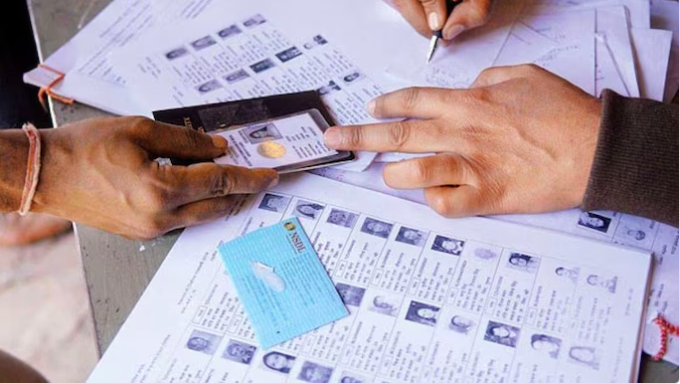
In a major breakthrough that may affect the process of updating electoral rolls nationwide, the Supreme Court on Monday ordered the Election Commission of India (ECI) to add Aadhaar and Elector’s Photo Identity Card (EPIC) to the current voter list revision exercise in Bihar. The ruling was made amidst rising criticism of the transparency and comprehensiveness of the voter authentication process.
???? Background: Voter Roll Revision in Bihar
The revision of the voter list in Bihar is one of the periodic exercises conducted by the ECI to exercise out duplicate, ineligible, or dead voters and infuse the database with fresh eligible voters. But controversy loomed large when petitioners went to the top court, sounding alarm over the draft list that supposedly omitted legitimate citizens and raised a serious threat of disenfranchisement.
Petitioners called on the court to stop publication of the draft list, citing procedural defects and challenging methods being applied for verification. Petitioners contended that those being left out of the draft list would be subjected to prolonged and cumbersome individual appeals, generating unnecessary legal and bureaucratic obstacles.
???? Court Questions EC’s Logic on Aadhaar and EPIC
The three-judge bench headed by Justice Suryakant cross-examined the ECI on why it refused to completely accept Aadhaar and EPIC as acceptable documents for verification during the voter roll process. The poll panel argued that Aadhaar is merely an identification proof, and not a citizenship proof, and hence could not be used exclusively to establish a voter’s entitlement.
But the high court resisted, saying:
“If your own list of documents acceptable includes things that are not conclusive evidence of citizenship, then how can you possibly exclude Aadhaar or EPIC? Any document on this planet can be faked.”
The bench underlined that both Aadhaar and EPIC are strong identity points, commonly utilized by all governance systems in India, and excluding them from the process of verifying votes is diluting the very aim of a clean and accurate voter roll.
⚖️ Fears of Exclusion and Disenfranchisement
The Supreme Court was very concerned about the risk of wrongful exclusions because of the ECI’s denial of these documents. Justice Suryakant observed that numerous citizens—particularly rural and marginalized ones—use Aadhaar or Voter ID as their first and perhaps sole documents of identity.
“This strict stance may result in systemic exclusion of bonafide voters. You are making the process inaccessible,” the court observed.
Several civil society groups have also raised this concern, cautioning that bureaucratic intricacies and uneven verification criteria may lead to bulk disenfranchisement, particularly among tribal, minority, and poor communities.
???? The Core Issue: Identity vs Citizenship
At the center of controversy is the age-old issue of disparity between citizenship and identity in voting. Aadhaar confirms the biometrics and identity of a person but does not automatically attest to the fact that the individual is an Indian citizen.
The ECI, being conservative in its approach, has so far never used Aadhaar as a final document to determine voter eligibility. However, in its earlier communications, it permitted the use of Aadhaar optionally for deduplication and enhancing voter roll purity.
But with the latest intervention by the court, the ECI is now being directed to reconsider its position and include Aadhaar and EPIC as part of its core verification armoury.
???? What’s Next?
It was not only the Election Commission that the Supreme Court asked to add Aadhaar and EPIC to the verification list but also instructed to lay bare its own position on the permissible documents.
Though the issue is still under court consideration, the court suggested that if the ECI did not consider a balanced and inclusive attitude, then the court may issue more stringent judicial directions in the weeks ahead.
????️ Wider Implications for India’s Electoral Process
The Bihar case has the potential to become a national precedent. If Aadhaar and EPIC are formally recognized as verification tools used to officially authenticate voters, it can greatly simplify the revision process and diminish instances of fictitious voting, duplication, and impersonation.
The case, however, also raises issues of privacy, data protection, and the possibility of citizens being excluded from being Aadhaar card holders or those without digital access.
Critics say that any initiative towards Aadhaar-based authentication should be supported by a robust legal framework and proper safeguards to avoid abuse of data and ensure that no deserving citizen is excluded.
????⚖️ Political Reactions and Citizens’ Voices
Political party leaders have responded guardedly. Some have embraced the call of the court to utilize Aadhaar and EPIC to clean up voter lists, while others have cautioned against excessive dependence on centralized databases without oversight and accountability.
Various voter rights groups have also made intervention petitions, requesting the court to hold that no voter should be purged from the rolls unless provided with advance notice and a chance to respond.
The Supreme Court order is a watershed in the way India’s democratic machine engages with its digital identity infrastructure. While the world’s largest democracy keeps improving its electoral processes, this case will be watched closely—not merely in Bihar but throughout India.
The trade-off between guaranteeing electoral integrity and citizen participation is a fine one, and the judiciary’s insistence on reasonableness and equity may open the door to an increasingly grey, technologically facilitated, and transparent voting system in the future.
