

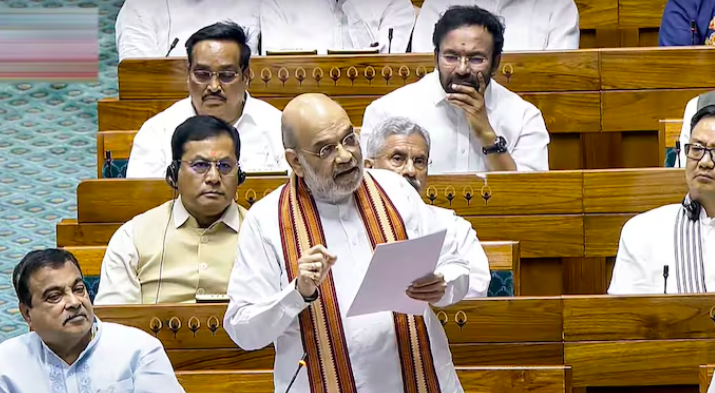
Union Home Minister Amit Shah was aggressive in Lok Sabha on Tuesday, reiterating that all three terrorists in Monday’s Operation Mahadev — an encounter in Srinagar — were Pakistani citizens. Shah asserted that these terrorists were the same ones behind the April 22 terror attack in Pahalgam and blamed senior Congress leader P Chidambaram for tricking the country by implying the attackers might be “homegrown.”.
“Proof Lies in Their Pockets and Their Intent”
Amit Shah asserted the central government possessed unequivocal proof connecting the murdered terrorists to Pakistan. “The three terrorists who were killed during Operation Mahadev were all Pakistani citizens. Two Pakistani voter ID cards have been recovered, and even the chocolates packed in their bags were made in Pakistan,” Shah claimed. He further said such facts could not be explained as coincidence and openly revealed the attackers’ source and support system.
“These are not baseless allegations,” Shah informed the House, “They have hard evidence behind them. The voter IDs, the snack and toilet item brands, even their online trail, all lead to Pakistan. Anyone who attempts to turn the narrative is doing grave injustice to the country.”
A Direct Attack on Chidambaram’s Remarks
Shah’s remarks were a reaction to Chidambaram’s initial comment that there was no tangible evidence to substantiate that the attackers had crossed from Pakistan. Chidambaram had urged “objective verification” and cautioned against jumping to conclusions, hinting at the possibility that the attackers could have been radicalised locally.
Reacting quickly, Shah stated, “By raising doubts on the established facts, Mr. Chidambaram is not only doubting our forces but also clearing Pakistan’s name. This is the second time he is doing this. As Home Minister, too, there used to be such vagueness in his words, which used to undermine our diplomatic position abroad.
He further stated that such comments are demoralizing for security personnel who put their lives at risk countering terrorism on the ground. “We owe it to our soldiers and our nation to call out terrorism for what it is and where it comes from,” he added.
Operation Mahadev: Inside the Encounter
Operation Mahadev, conducted in the Lal Chowk district of Srinagar on 28th July, saw the neutralisation of three weaponised terrorists following a long-haul gunfight. The trio was identified as being affiliated with the outlawed terror group Lashkar-e-Taiba and was working with direct backing from across the border, confirmed security sources.
Official sources in the Ministry of Home Affairs confirmed that the operation had been planned over weeks, after it was obtained through intelligence intercepts and mobile surveillance. The militants, who had escaped capture after the April 22 Pahalgam attack in which seven people were killed, were located at a hideout in central Srinagar.
Amit Shah praised the security forces for their “surgical precision” and “heroic determination” in successfully completing the operation with no civilian casualties. “Their bravery made sure that a greater tragedy was avoided,” Shah observed.
Political Reactions: BJP-Congress War of Words
BJP did not take much time in echoing Shah’s statement, launching a fierce attack on Congress leadership. BJP spokesperson Sudhanshu Trivedi stated, “Chidambaram is living in a bubble. Each time there’s a terror attack, Congress somehow goes out of its way to clear Pakistan. Why are they doing this? What makes them rise to defend enemy narratives?”
Congress, on the other hand, took a stand with Chidambaram’s appeal for evidence-based debate. Party spokesperson Supriya Shrinate said, “The Home Minister is attempting to politicise a security matter. Mr. Chidambaram merely requested good evidence before accusing another country. That’s not anti-national — that’s responsible politics.”
A Recurring Pattern: Shah References Past Incidents
Amit Shah also mentioned previous attacks and what he called “a consistent reluctance” of some Congress leaders to identify Pakistan. Referring to the Pulwama, Uri, and 26/11 Mumbai attacks, Shah pointed out that in all instances, early hesitation or false narratives only served Pakistan’s denial apparatus.
“While Pakistan indulges in terror, it also stages a worldwide PR. To this campaign, regretfully, is added that of leaders like Chidambaram, who question facts,” Shah countered.
He reaffirmed that the policy of India under Narendra Modi is zero tolerance to terror and zero ambiguity about its source. “Our security strategy is clear: every bullet fired back, every falsehood will be brought to light,” he declared.
A Warning for the Future
Shah ended his address on a stern note: “Terrorists can no longer take cover behind proxy wars or disguise themselves behind false identities. The world is watching, and India is no longer silent. Whoever casts doubt upon our inputs of intelligence or disparages our forces for political reasons needs to reconsider their priorities.”
He also appealed to all political parties to move above partisan politics when dealing with national security. “There can be disagreements on policy, economics, or welfare. But on issues relating to terrorism and national sovereignty, the nation has to speak in one voice.”
What Lies Ahead
As the Operation Mahadev dust settles, the political war over the identity of the Pahalgam attackers remains on the rise. While the BJP is making use of the incident to highlight its hardline attitude towards terror, the Congress seems eager to present itself as the voice of constitutional caution and diligence.
But one thing is certain: national security, particularly in Kashmir, continues to be one of the most politically charged and emotionally sensitive issues in Indian politics. And with elections in a number of states imminent in the next few months, anticipate many more showdowns at the nexus of politics, terror, and evidence.
