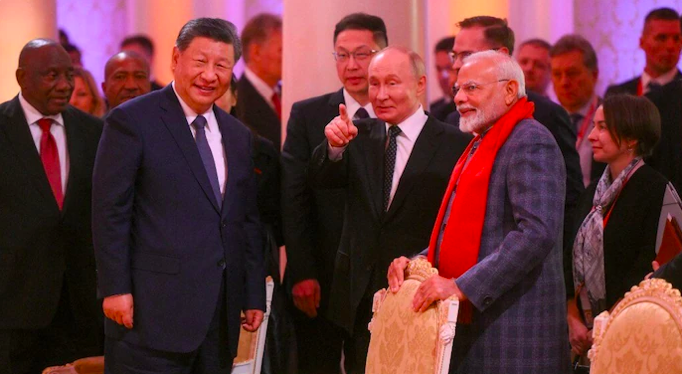
With tensions between the United States and a number of key world economies continuing to build, Chinese leader Xi Jinping will host a prominent meeting at the Shanghai Cooperation Organisation (SCO) summit later this week. The summit, which will take place from August 31 to September 1 in Tianjin, China, will have Russian President Vladimir Putin, Indian Prime Minister Narendra Modi, and leaders from all of Central Asia, South Asia, Southeast Asia, and the Middle East attending. Analysts opine that the summit is not only a diplomatic gathering, but also a deliberate show of solidarity to counterbalance U.S. trade and geopolitical pressure.
The summit takes place at a moment when the confrontation between the BRICS countries and U.S. President Donald Trump is escalating. Trump’s bold tariff action and economic actions against China, India, and other emerging markets have created the stage for a wider conflict on trade, technology, and world leadership. Against this backdrop, Xi’s hosting of the SCO summit is widely seen as a strategic move to project unity among major regional powers and to demonstrate that American economic coercion has not deterred the emerging multipolar world order.
“Xi will want to take the summit as a chance to exhibit how a post-American-dominated global order is starting to appear and that every White House initiative since January to push back against China, Iran, Russia, and now India has not been the hoped-for outcome,” said The China-Global South Project editor-in-chief Eric Olander. The summit, in the words of analysts, aims to tell Washington that the world is evolving into a diversified global leadership paradigm, in which the United States’ clout is no longer single-handedly dominant.
The SCO, now a body with 10 permanent members and 16 observer countries, has increasingly become a forum for promoting regional coordination and expressing collective interests in the wider world. Although the organization was founded originally in 2001 to deal with regional security concerns, its scope has been broadened to encompass economic cooperation, cultural exchange, and diplomatic coordination among member states over the years. Still, the SCO remains challenged to turn its grand expectations into concrete realities. Takshashila Institution’s Manoj Kewalramani notes, “What is the clear vision that the SCO embodies and its operational effectuation are quite hazy.” In spite of such doubts, the bloc’s potential to act as a counterweight to U.S.-driven initiatives continues to hold relevance.
The current year’s summit also is especially important in the context of Sino-Indian relations. India and China have had periods of increased tension between them in recent years, most prominently in regard to border conflicts in the Himalayas. Analysts say the SCO summit provides both countries the chance to de-escalate these tensions and promote greater cooperation. “It’s probable that New Delhi will swallow their pride and leave this year’s SCO issues in the past as an effort to keep the momentum in the detente with China,” Olander said. Much is hoped for the summit to announce troop withdrawal, easing of trade and visa sanctions, and other confidence-building measures. These would set the stage for greater cooperation on issues from climate change to regional connectivity.
The larger geopolitical perspective also adds to the significance of this summit. BRICS countries, led by China, Russia, India, Brazil, and South Africa, have grown more assertive in both economic and political terms on the global front. Analysts claim that these nations’ deepening economic interdependence and diplomatic cooperation have unnerved the U.S. administration, leading to actions like higher tariffs and trade barriers. The SCO, though different from BRICS, supplements these initiatives by offering a platform for Eurasian and Asian powers to come together with common interests and show a unified face against the glare of outside pressures.
While its increasing relevance, the SCO has limited capacity to deal with fundamental security issues. Though the organization has held joint military exercises and collaborated on counterterrorism efforts, analysts note that its power in terminating geopolitical disputes is still developing. Yet the emphasis of the summit on unity, cooperation, and multipolarism mirrors a broader trend in global governance: the rise of non-traditional structures of power contesting Washington-based hegemony.
Chinese leaders have always positioned the SCO as “an important force in building a new type of international relations.” In hosting this year’s summit with big-name visitors like Putin and Modi, Xi Jinping wants to highlight China’s leadership at the forefront of this new order. The meeting also sends a message to the global community that the participating countries are ready to work more closely together on issues of economics, politics, and security, even as tensions with America increase.
For India, the summit presents a fine balance. Keeping its bilateral ties with the U.S. strong is essential, but membership in the SCO enables New Delhi to engage with its immediate neighbors in the region and capitalize on its position in shaping the changing geopolitical contours of Asia. The possible agreements on managing troops, facilitating trade, and cross-border coordination could add to stability in the region and reinforce India’s position as an indispensable player in Asia’s future multipolarity.
With the SCO summit on the horizon, international eyes will be glued to the outcome of this high-level gathering. Aside from the pomp and circumstance of the formal meetings and signed agreements, the event represents a symbol of resiliency among rising powers and a strategic counter-narrative to U.S.-led policies. Experts contend that the summit’s true importance is not merely in the choices being made within the conference rooms of Tianjin, but in the larger message it conveys: the 21st-century global system is growing more multipolar, and states such as China, India, and Russia are busy designing its shape.
In summary, the next SCO summit is a nexus of diplomacy, strategy, and symbolism. By welcoming leaders like Vladimir Putin and Narendra Modi, Xi Jinping is announcing China’s intention to consolidate regional coalitions, resist U.S. dominance, and advance a vision of global governance with cooperation among rising powers as its priority. Whether the SCO’s real influence on security and economic policy will keep changing over time, its function as a vehicle for advancing collective interests in opposition to one-sided actions cannot be denied. As the world looks on, the summit will become a moment of reckoning in the existing rivalry between the traditional and the new centers of power.
Xi Hosts Putin, Modi Amid Trump’s Tariff Threats