


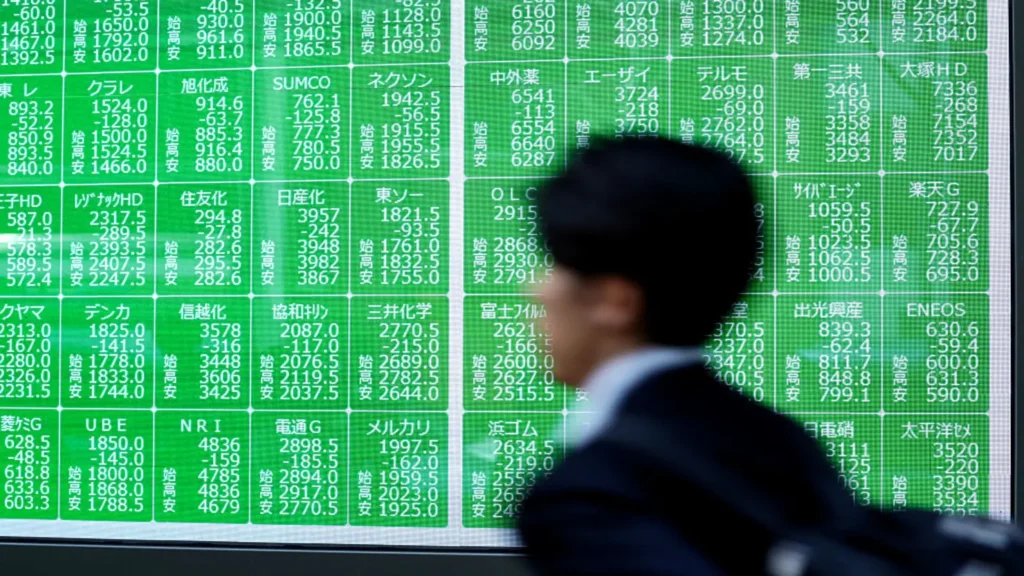
Investors Flock to Japan in April Amid U.S. Market Jitters
In a remarkable shift in global capital flows, Japan saw record-breaking foreign investment in April as global investors moved out of U.S. markets and sought safer alternatives. The sudden surge of interest in Japanese equities and long-term bonds marked the highest monthly inflows since records began nearly three decades ago.
Foreign investors purchased 8.21 trillion yen ($56.6 billion) in Japanese stocks and long-term bonds last month, according to Japan’s Ministry of Finance. The data, compiled since 1996, confirms April as a historic high in terms of net inflows.
What Drove the Surge into Japanese Assets?
The “Sell U.S.” Narrative Gains Momentum
A major catalyst behind the shift was a growing unease among global investors about the U.S. economy. Rising interest rates, persistent inflation, and renewed trade tensions under President Donald Trump’s administration—particularly his broad-based tariffs—have weakened confidence in American markets.
“It was quite an exceptional month, when you consider everything that has happened in the global macroeconomic environment,” said Kei Okamura, a portfolio manager focused on Japanese equities at Neuberger Berman.
The sharp sell-off in U.S. markets pushed investors to diversify away from American assets, leading many to turn toward Japan—a country seen as a relative haven during periods of global instability.
Japan’s Safe-Haven Appeal Strengthens
Japanese markets have long been viewed as a stable option for international investors during times of uncertainty. While the nation continues to face its own economic challenges, such as demographic decline and low long-term growth, its strong corporate balance sheets, disciplined central bank, and geopolitical stability remain attractive.
“Japanese assets are generally considered a haven, whose appeal rose as the ‘sell-U.S.’ narrative gained ground in April,” said Rashmi Garg, senior portfolio manager at Al Dhabi Capital.
The appeal of Japanese equities has also been boosted by ongoing structural reforms, improved corporate governance, and stronger earnings reports from several large-cap companies.
Global Diversification in Action
Analysts say the record inflows were a clear sign of a rebalancing of global portfolios, with investors increasingly seeking to diversify away from U.S.-centric strategies.
“Trump tariff shocks likely changed global investors’ outlook on the U.S. economy and asset performance,” said Yujiro Goto, head of FX strategy at Nomura. “That likely led to diversification away from the U.S. to other major markets including Japan.”
This trend reflects a broader movement among institutional investors to hedge geopolitical and economic risks by reallocating capital across more balanced global positions.
Bonds and Equities: A Dual Attraction
What makes April’s data even more remarkable is the balanced nature of the inflows. Foreign investors poured capital into both Japanese equities and long-term government bonds—an indication of confidence not just in short-term market trends but also in Japan’s macroeconomic stability.
Equities benefited from optimism around Japan’s corporate reform agenda and the resilience of its export sector, while long-term bonds gained traction amid speculation that Japan’s interest rates will remain relatively low compared to the U.S.
What’s Next for Japanese Markets?
While April was clearly a standout month, the key question is whether this momentum will continue.
Much will depend on how the U.S. economy evolves, particularly in response to trade tensions and interest rate policies. If investor sentiment toward U.S. markets remains cautious, Japan could continue to attract inflows as a stable, lower-risk alternative.
However, Japan will also need to maintain its reform momentum and economic stability to keep investor confidence high. Any signs of domestic political instability or economic slowdown could quickly reverse the trend.
Final Thoughts: A Reminder of Japan’s Enduring Investment Case
The record inflows into Japan’s financial markets in April serve as a reminder that, even in a complex global economy, long-term fundamentals and relative stability matter.
With the U.S. facing renewed scrutiny over its trade and fiscal policies, and global investors looking for alternatives, Japan has re-emerged as a key destination for capital looking for safety and structure.
Whether this shift marks the beginning of a longer-term realignment remains to be seen. But for now, Japan is once again on the radar as more than just a defensive play—it’s a market with real momentum.