


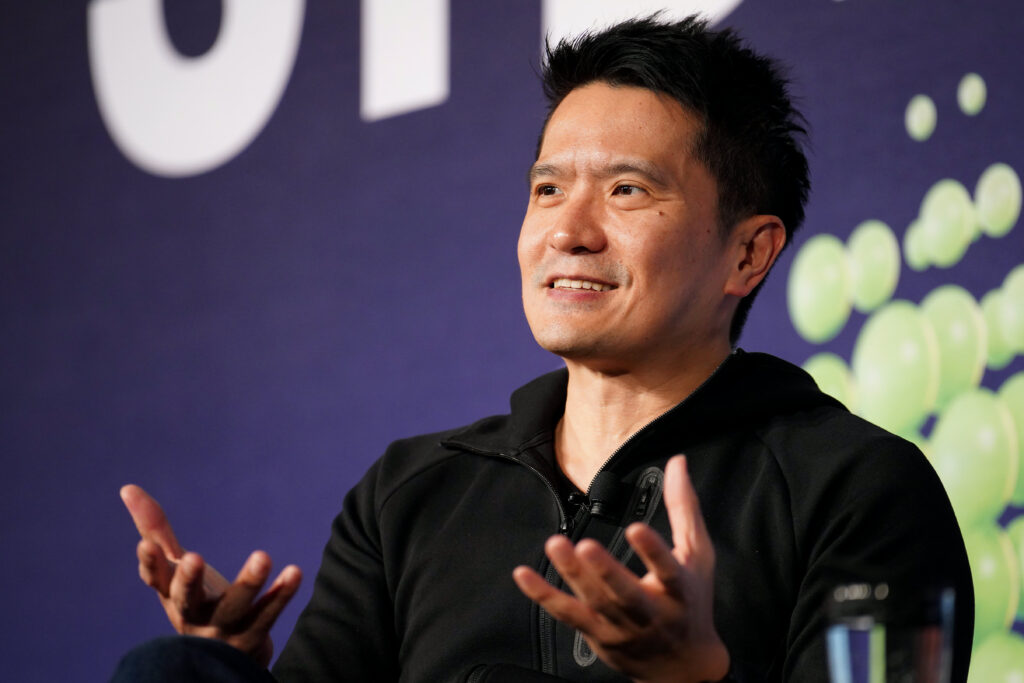
Razer CEO Min-Liang Tan warns the gaming world is about to change forever as AI takes over how games are made, played, and experienced.
The gaming world is on the edge of a revolution — and one of its biggest names just sounded the alarm.
Min-Liang Tan, the billionaire co-founder and CEO of gaming giant Razer, says artificial intelligence will “completely disrupt everything” in the global gaming industry.
From how games are created to how they’re played, Tan believes AI is about to flip the $189 billion gaming ecosystem upside down — and it’s happening faster than anyone expects.
“AI Is Going to Change Everything in Gaming”
Speaking on CNBC’s Beyond the Valley podcast, Tan didn’t sugarcoat what’s coming.
“For us at Razer, the way we see it is that AI is going to completely disrupt everything, or change everything in gaming,” he said.
And when a gaming billionaire says “everything,” he means it. Tan predicts that in just one year, gamers could see AI-built blockbuster titles hitting the market — games designed, coded, and optimized largely by artificial intelligence.
Imagine an entire game — storylines, levels, characters, and even player interactions — generated by algorithms that learn and adapt as you play. That future isn’t a decade away. Tan says it’s around the corner.
Billions of Players, Billions in Play — and a Massive Disruption Coming
According to research firm Newzoo, gaming now has 3.6 billion players worldwide and generates nearly $189 billion annually.
That’s bigger than the global movie and music industries combined.
But if Tan’s prediction is right, the way those billions are earned — and who earns them — could soon change dramatically.
Smaller indie studios equipped with AI tools may soon rival major publishers like EA or Ubisoft. The creative barrier to entry is falling fast, and Tan says the entire system is about to be rewritten.
The AI Takeover Has Already Started
It’s not science fiction anymore — AI is already creeping into the development process.
Studios are using machine learning to generate 3D environments, write dialogue, compose in-game soundtracks, and even balance game difficulty in real time.
That means developers can build massive, complex worlds in weeks instead of years — and at a fraction of the cost.
Tan believes this shift will redefine what’s possible in gaming. “AI is not just a tool,” he said. “It’s a creative partner. It’s going to change the way we think about design, storytelling, and even how we experience games.”
From Developers to Gamers — No One Escapes the AI Revolution
Tan warns that the disruption will touch everyone — developers, publishers, and players alike.
For developers, AI will handle tedious coding and animation tasks, freeing up time for creative experimentation. For publishers, it could transform the economics of the industry, cutting costs while boosting output.
And for gamers? Get ready for smarter, more adaptive, and infinitely replayable experiences.
Games could soon evolve based on your behavior, learn your strategy, and tailor challenges uniquely for you. Every playthrough could feel like a new game.
But Not Everyone’s Ready
While Tan is optimistic, the rise of AI in gaming raises tough questions.
Who owns AI-generated content? How do developers protect creativity when machines can design faster than humans? And what happens to jobs as AI takes over parts of the production pipeline?
Some in the gaming community are already worried that automation could flood the market with generic, copycat titles. Others fear that overreliance on AI could erase the human touch that makes games emotionally powerful.
Still, Tan believes innovation will win out. “Every major shift in technology has created fear — and then it’s created opportunity,” he said. “This will be no different.”
The Future of Gaming: Built by Machines, Played by Humans
If Tan’s prediction is right, we’re standing at the dawn of an entirely new gaming era — one where AI builds the worlds we escape into.
The next blockbuster hit might not come from a famous studio or a celebrity designer — it could come from an AI system fine-tuning gameplay in real time for millions of users.
And with billions of dollars and billions of players on the line, the race to harness AI could determine the winners and losers of the next decade in gaming.
The Bottom Line: The Game Will Never Be the Same
AI isn’t just another tool in the developer’s kit — it’s the game-changer that could redefine everything from storytelling to business models.
Razer’s Min-Liang Tan isn’t exaggerating when he says the disruption will be total. The only question now is: who will adapt, and who will get left behind?