

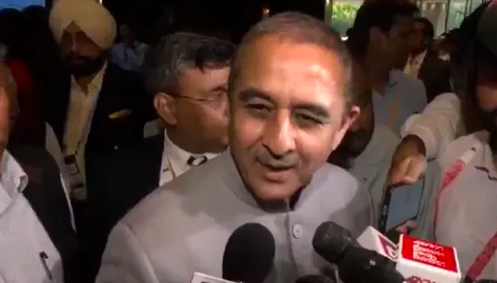
The Narendra Modi administration has made its first formal reaction after the United States imposed a sharp 50% tariff on Indian products on Wednesday. Union Minister of State for External Affairs, Kirti Vardhan Singh, was hopeful about India’s capacity to absorb the trade shock, emphasizing the “resilience and strength” of the Indian economy.
Addressing journalists, Singh emphasized the volatility of global politics and trade relations, commenting:
“You see, the world is constantly changing — the political atmosphere, the climate for investment, the business… it’s constantly changing. And we are well-equipped to encounter any contingency. Our economy is expanding; it’s robust and resilient.”
The minister’s remarks are on the very day when the U.S. officially doubled tariffs on a broad array of Indian goods, raising fears in industries like textiles, pharma, auto components, and IT services. The action is viewed broadly as part of President Donald Trump’s tough trade approach, aimed at shielding local industries before the 2026 U.S. mid-term polls.
A stern test for India’s exporters
The 50% tariff, effective immediately, threatened billions of dollars’ worth of Indian exports. The largest trading partner of India is the United States, which conducts almost $120 billion worth of bilateral goods trade with India every year. With higher duties, Indian goods could become uncompetitive against competitors in Southeast Asia, Latin America, and Africa — which now have preferential or lower tariff arrangements with Washington.
Sectors likely to be most affected are:
Textiles and apparel, a manpower-intensive industry employing millions in India.
Generic drugs, where India has traditionally been a key supplier to America.
Auto component and engineering products, which make up a major percentage of Indian exports to America.
IT services and outsourcing, although not tariffed directly, may be subject to indirect pressure through straining visa policies and cross-border regulatory barriers.
Trade experts have warned that smaller exporters, who already face thin margins, may struggle to stay afloat, while larger conglomerates may seek to diversify markets in Europe, the Middle East, and Africa.
Modi’s upcoming China visit in focus
The timing of Prime Minister Narendra Modi’s upcoming visit to China for the Shanghai Cooperation Organisation (SCO) summit has sparked renewed attention. The trip, scheduled for the end of August, comes amid a subtle thaw in India-China relations, with both nations recognizing the need to recalibrate their positions in a shifting global trade environment.
Singh, when questioned regarding the meaning of the China visit against the backdrop of U.S. behavior, was upbeat but cautionary:
“India’s foreign policy is driven by its own national interests. We interact with all international partners, and the SCO is a significant platform. The dialogue and cooperation are vital when the world economy is uncertain.”
Witnesses say that the SCO summit might offer a platform for India and China to reach convergence on matters such as trade diversification, supply chain resiliency, and technology alliances. While border friction has characterized the bilateral relationship in recent years, Washington’s tariff war might open a limited room for pragmatic cooperation.
Resilient economy, uncertain future
Kirti Vardhan Singh’s reassurance captures the confidence of the Modi government in India’s domestic growth momentum. With GDP expected to grow by more than 7% in FY2025-26, India is still the world’s fastest-growing major economy. Domestic consumption, increasing infrastructure projects, and digital innovation are likely to mitigate some of the damage from U.S. tariffs.
The position is, however, not without risk. Economists warn that:
Slowdown in exports might dent employment generation, especially in manufacturing centers in Gujarat, Maharashtra, Tamil Nadu, and Karnataka.
Trade deficits are likely to expand India’s current account deficit if imports keep going up while exports are hindered by barriers.
Geopolitical tensions could make global investor sentiment cautious.
Former diplomats believe that India will have to walk a tightrope with its relationship with the U.S. while strengthening strategic interactions with Europe, Japan, and ASEAN nations.
Political and diplomatic responses
The US action has set off political commotion in India. Opposition politicians have condemned the Modi administration for “not being able to protect exporters” and urged an immediate review of trade policy. A few have asked for retaliatory duties, while others say there should be an acceleration of FTAs pending with the EU, Britain, and the Gulf.
In the government, the message is that of quiet preparation. External Affairs Minister S. Jaishankar will be conducting consultations with top officials and trade negotiators to consider India’s choices. Industry associations like CII, FICCI, and ASSOCHAM have pressed the government to provide relief measures, ranging from credit support, export incentives, and faster trade facilitation with substitute markets.
The bigger picture
The tariff increase reflects the larger reality of an evolving global order. As Kirti Vardhan Singh eloquently expressed, “the world is always changing.” For India, this is both a challenge and an opportunity:
A challenge, since short-term export earnings and employment might be jeopardized.
An opportunity, as it forces India to diversify trade, enhance domestic industry, and quicken reforms that make it more autonomous.
International trade analysts feel India could end up being the stronger one if it can make use of its huge domestic market, drive technology innovation, and increase regional trade ties. The next few months will be decisive in determining whether New Delhi is able to capitalize on crisis.
As Prime Minister Modi prepares to set off to China for the SCO summit, India stands at the juncture of a complex web of global trade. U.S. tariffs have given a jolt, but the government’s first official statement of resilience and adaptability is a clear indication that New Delhi is set for a long game.
Whether by diversifying away, by diplomacy, or at home, India’s capacity to weather these headwinds will challenge its economic resilience as much as its foreign policy adaptability.
In the meantime, as Singh reminded reporters, India’s message is unmistakable: the world may be constantly evolving, but India aims to stay constant.
