

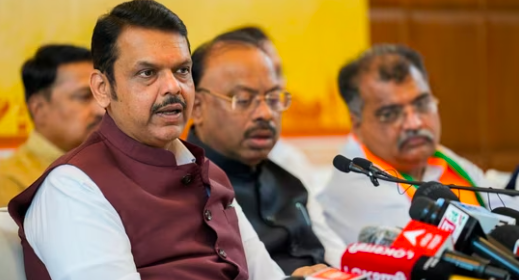
Maharashtra Deputy Chief Minister Devendra Fadnavis sharply criticized Bharatiya Janata Party (BJP) Member of Parliament Gopal Shetty on Tuesday after Shetty made a violent remark targeting Shiv Sena (UBT) chief Uddhav Thackeray. The controversy erupted as political tensions escalate in Maharashtra following the Lok Sabha election results and ahead of the upcoming state assembly polls.
Shetty, in a widely-circulated video, had suggested that Thackeray “deserved to be beaten with shoes” for allegedly betraying BJP and forging alliances with rivals to form the Maharashtra government in 2019. The remarks quickly drew widespread condemnation from opposition leaders and civil society groups.
Opposition Demands Action, BJP Attempts Damage Control
Senior leaders from Shiv Sena (UBT), the Congress, and the NCP voiced outrage over Shetty’s language, alleging that it incited violence and set a dangerous precedent. “Such comments have no place in democracy,” said Congress spokesperson Sachin Sawant. “The BJP must act against its leader for this venomous rhetoric.”
In response to mounting criticism, Fadnavis held a press conference to clarify the party’s position. “The BJP does not endorse any kind of violence or personal attacks,” Fadnavis stated. “No one has the right to make such unacceptable comments, regardless of partisan differences. Our political discourse must remain within the bounds of decency and democracy.”
Fadnavis further assured that the party’s disciplinary committee would review Shetty’s statement and take appropriate action, signaling an attempt to project the BJP as a party committed to civility in public life.
Context: Growing Polarization Ahead of Maharashtra Elections
The incident comes amid a highly polarized political climate in Maharashtra. The Shiv Sena-BJP alliance fractured in 2019 when Uddhav Thackeray broke away to form a government with the Congress and NCP, leading to an ongoing feud between the erstwhile partners.
Political analysts note that inflammatory rhetoric has increased in the lead-up to the 2024 Maharashtra Assembly elections, with leaders trading personal barbs and accusations. “Party competition is at an all-time high, and unfortunately, this often spills over into toxic language that degrades democratic debate,” said political commentator Sujata Anandan.
Broader Pattern of Political Rhetoric Under Scrutiny
This is not the first time a BJP leader has faced backlash for provocative statements. In recent years, several party members have been admonished by central leadership for remarks perceived as anti-democratic or violent. Fadnavis’s swift condemnation underscores the party’s sensitivity to public perception, especially after a less-than-expected performance in the 2024 Lok Sabha polls.
Commentators suggest that by distancing itself from Shetty’s comments, the BJP aims to reassure moderate voters and avoid giving ammunition to opposition parties ahead of the high-stakes Maharashtra elections.
Reactions from Civil Society and Observers
Rights organizations and civil society groups have also weighed in, urging all political leaders to uphold values of non-violence and mutual respect. “With political violence on the rise across India, such rhetoric can have dangerous real-world consequences,” said social activist Medha Patkar. “Parties must set clear examples if democracy is to flourish.”
What’s Next: BJP Faces Pressure to Act
As the controversy continues to play out, all eyes are on the BJP’s disciplinary process and whether tangible consequences will follow for Gopal Shetty. Opposition parties have indicated they will continue to raise the issue both in the state assembly and on social media to keep the matter in public view.
Fadnavis’s rebuke is seen as an important message to his party cadre and to the broader political establishment that advocacy of violence, even in rhetoric, will not be tolerated.
